

The UAE’s e-invoicing rollout is moving into its first mandatory implementation phase. Businesses should firstly confirm whether they are included in Phase One, confirm which phase and deadline applies to them, select an Accredited Service Provider (ASP) and prepare their systems, data and finance processes.
As a quick reminder, when we talk about e-invoices, we are talking about structured, machine-readable invoice data that is issued and exchanged electronically between a supplier and a buyer, and reported to the Federal Tax Authority. A PDF invoice, scanned document, image or emailed attachment is not an e-invoice under the UAE system. The current rollout focuses on business-to-business and business-to-government transactions; B2C transactions are currently excluded.
Which deadlines apply?
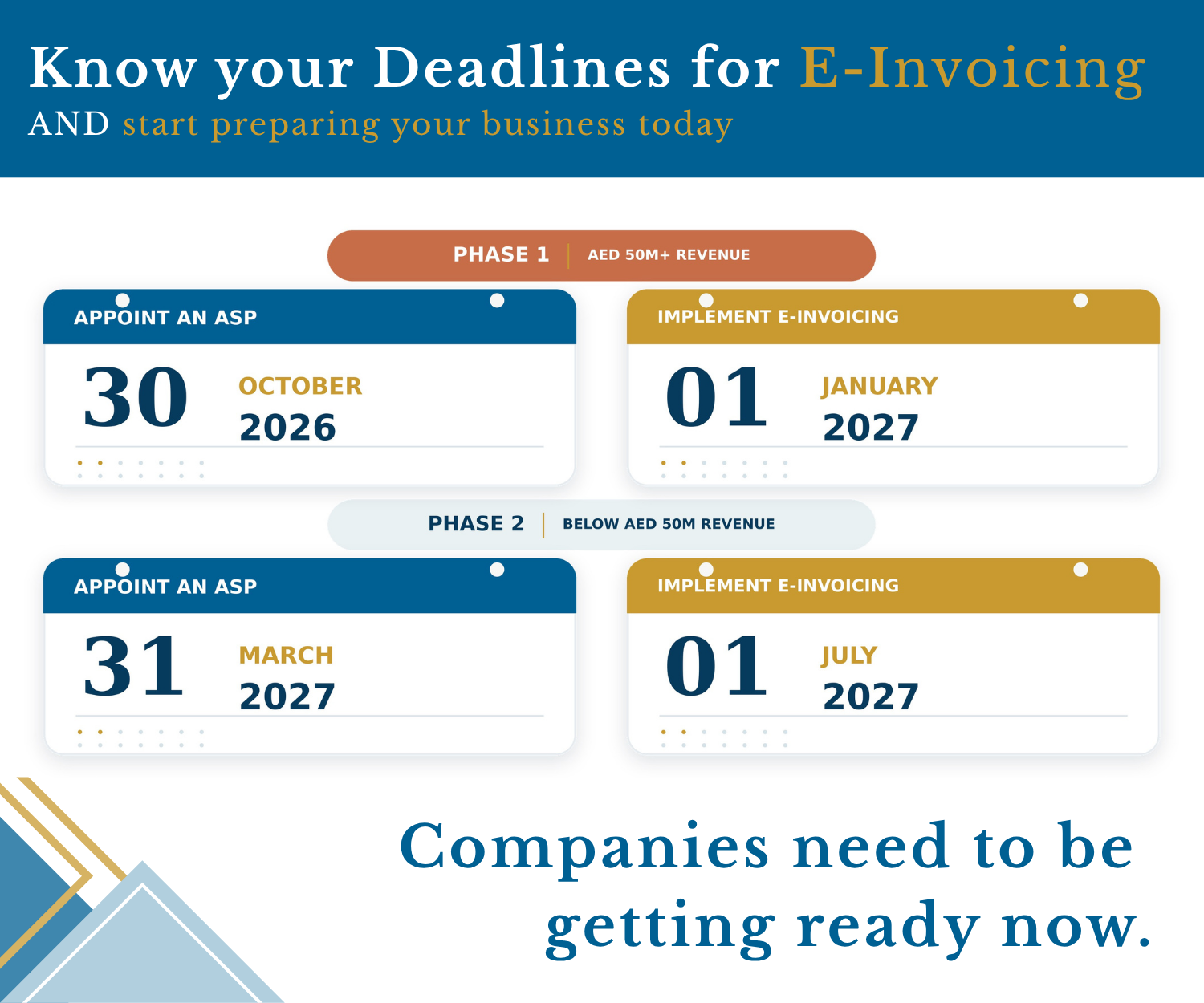
The rollout is phased. Businesses with annual revenue of AED 50 million or more must appoint an ASP by 30 October 2026 and implement e-invoicing by 1 January 2027. Businesses with annual revenue below AED 50 million must appoint an ASP by 31 March 2027 and implement e-invoicing by 1 July 2027. Specific exclusions apply, so confirm that your business is within scope as well as checking the revenue band that determines its phase.
Choose an ASP and check your current system
An ASP provides the accredited technical service that enables a business to issue, exchange and report e-invoices through the UAE system. Choosing a provider is only one step: the business will also need to agree how the service will connect with its accounting or business system, what information must be mapped, and who will manage testing and implementation.
If your business relies on an accountant or another provider to issue invoices, start by asking which system they use and whether it can connect to an ASP. Check the integration, onboarding and testing work involved before deciding whether your current setup needs to change.
Prepare the data and finance process
The main work is often in the data and process behind the invoice. Outdated or disconnected accounting and business systems, manual approvals and incomplete customer or supplier records can complicate implementation. Review how invoices are created, approved, sent and recorded, and check that customer and supplier details are accurate. Include finance, IT and the teams that create or approve invoices in the planning.
The webinar Q&A also highlighted the need to test invoice corrections. Grant advised that if an incorrect invoice has passed through the ASP network and reached the customer’s system, it should be corrected with a tax credit note and a replacement invoice. Ask your ASP how this will work in your setup, and include credit notes, cancellations and reissues in your testing.
Preparing for e-invoicing gives businesses an opportunity to strengthen finance operations. Better data and connected invoice processes can improve financial visibility, support better decisions and create a stronger foundation for growth.
A practical starting point
Businesses in Phase 1 (with AED 50 million or more in revenue) need to act now, by appointing an ASP by the 30 October 2026 deadline and being ready to implement by 1 January 2027.
Businesses in Phase 2 can use a structured 90-day roadmap: assess gaps in the first 30 days, improve processes and data in the next 30, then begin implementation.
Whatever phase you are in, you need to factor in the time it takes for system integration, process improvements, transaction testing and staff training.
- Confirm whether your business transactions must use e-invoicing, your revenue band (to determine what phase you are in), and the applicable dates.
- Review your accounting or ERP system, invoice processes and customer and supplier data.
- Compare suitable ASPs and understand the integration, onboarding and testing work involved.
- Plan how you’ll receive and approve incoming e-invoices, not just how you’ll send them.
- Assign responsibility across finance, IT and the teams that create or approve invoices.
- Build a delivery plan that leaves time to clean data, test transactions and train staff before implementation.
TLB Group can help businesses assess readiness, identify gaps in finance processes and data, and develop a structured action plan. Contact TLB to discuss your implementation timeline and the support your business needs.
Editorial references
Ministry of Finance deadline amendment