
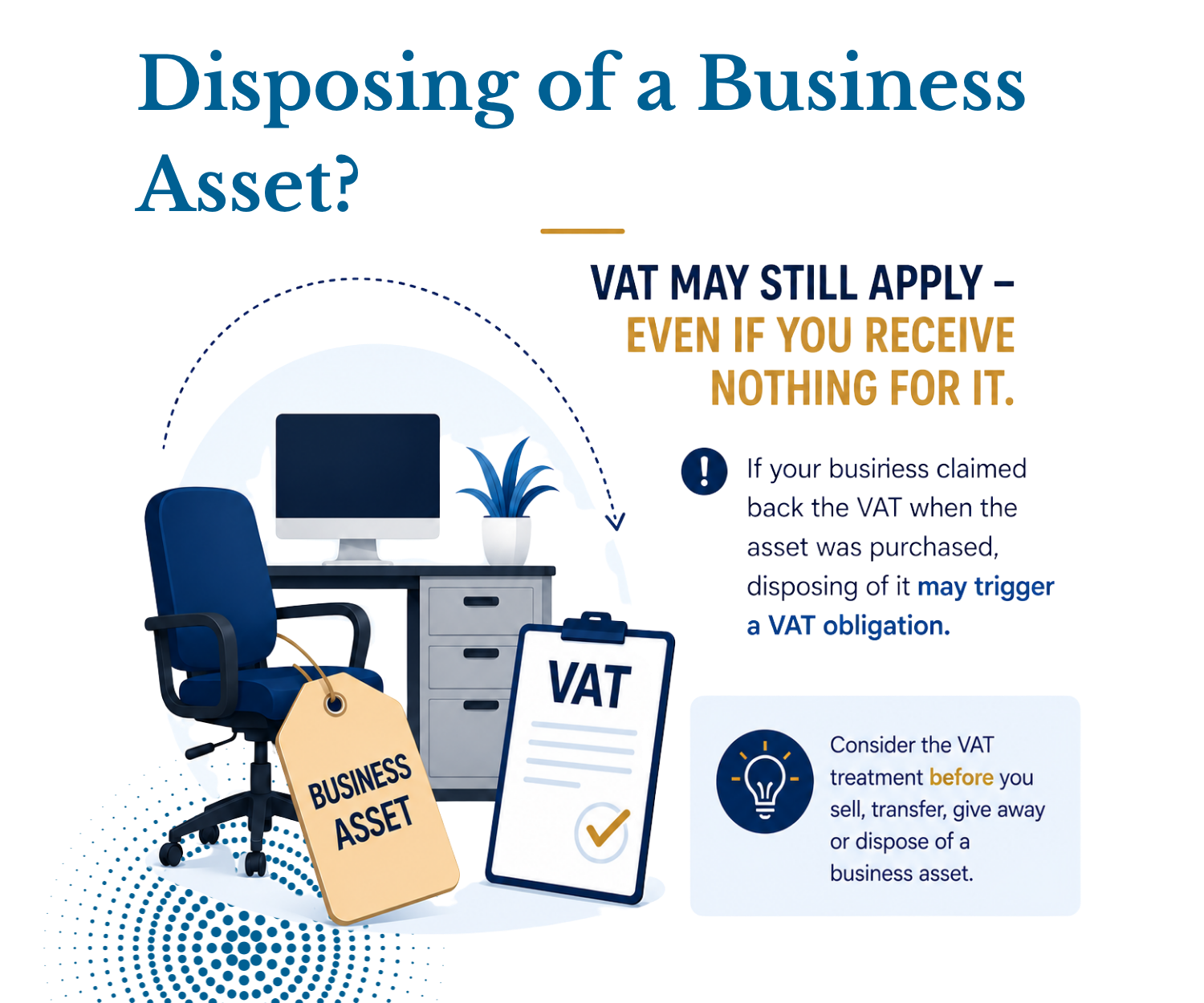
It is easy to assume that if a business asset is not being sold, there is no VAT to consider. However, that is not always the case.
Where a business recovered input VAT when purchasing an asset, subsequently disposing of it may create a VAT obligation—even if the asset is given away and the business receives nothing in return.
The correct treatment will depend on how the asset is disposed of, whether input VAT was recovered and whether one of the available exceptions applies.
Was VAT recovered when the asset was purchased?
This is the first question to check.
If the business recovered input VAT when purchasing the asset, disposing of it for no consideration may be treated as a deemed supply for VAT purposes. This could require the business to account for output VAT even though it has not received a payment.
Where no input VAT was recovered, the deemed-supply rules may not apply. However, the circumstances of the disposal should still be reviewed before reaching a conclusion.
How is the asset being disposed of?
The VAT treatment can vary depending on what is happening to the asset. For example, is it being:
- Sold to another party?
- Transferred to another business or related party?
- Donated or given away?
- Scrapped or otherwise removed from the business?
- Retained when the business deregisters for VAT?
A sale will ordinarily be considered a supply for VAT purposes. A transfer or disposal for no consideration may instead fall within the deemed-supply rules.
The accounting entry alone does not determine the VAT outcome. A business should consider what has physically and legally happened to the asset.
Does an exception apply?
Not every disposal creates a VAT liability.
An exception may apply where input VAT was not originally recovered. Specific rules may also apply to qualifying transfers of an entire business, or an independent part of a business, to another taxable person who will continue operating it.
Limited exceptions also exist for certain commercial gifts, samples and low-value deemed supplies. The relevant conditions and thresholds must be considered carefully rather than assuming that every low-value disposal is automatically excluded.
How should the disposal be valued?
Receiving no payment does not necessarily mean that the VAT value is zero.
Where a disposal is treated as a deemed supply, the business may need to determine the value in accordance with the UAE VAT valuation rules. This is generally linked to the costs incurred in making the deemed supply, although other valuation rules may apply in particular circumstances.
Businesses should retain evidence supporting both the selected value and the method used to calculate it.
Does the disposal need to be reported?
Where the disposal is treated as a taxable or deemed supply, the business may need to:
- Account for output VAT;
- Include the transaction in the VAT return for the relevant tax period;
- Issue or retain the appropriate tax documentation; and
- Maintain records explaining the disposal and the VAT treatment applied.
Recording the transaction correctly when it occurs is considerably easier than trying to reconstruct the details during the preparation of a VAT return or an FTA review.
Take particular care when closing or deregistering a business
Business closure and VAT deregistration require additional attention.
Goods and services owned by a taxable person at the date its VAT registration is cancelled may be treated as deemed supplies. The business may therefore need to account for VAT on remaining assets as part of its final VAT position.
Before submitting a deregistration application or final VAT return, businesses should review their asset register, identify any remaining business assets and confirm whether input VAT was previously recovered.
The key takeaway
Consider the VAT treatment before selling, transferring, donating, scrapping or otherwise disposing of a business asset.
A short review at the beginning can help the business apply the correct treatment, retain the necessary evidence and avoid discovering an unexpected VAT obligation when preparing its return.
This article provides general information only. The appropriate VAT treatment will depend on the specific circumstances of each disposal.